

The international role of the euro, June 2026
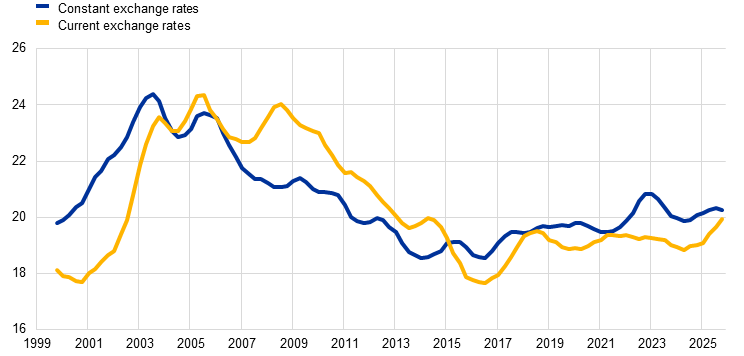
The international role of the euro grew moderately in 2025, with its share across various indicators of global currency use reaching around 20%. Viewed from a longer-term perspective, the role of the euro has grown gradually but steadily. Since the escalation of geopolitical tensions triggered by Russia’s invasion of Crimea in 2014, the euro’s share has increased by about 1.5 percentage points. Throughout this period, the euro has remained the world’s second most important currency.
Several developments in 2025 were noteworthy. Issuance of international debt denominated in euro reached its highest level since the currency’s inception. The euro became the leading currency in the green and sustainable international bond market. Foreign portfolio inflows to the euro area were significant. And there were signs that the euro behaved like a safe-haven currency during several risk-off events that marked 2025 and early 2026.
At the same time, there is no room for complacency. Forces of fragmentation are becoming more pronounced. Geopolitical tensions continue to drive strong central bank demand for gold. Several countries are making progress on tech-driven alternatives to traditional cross-border payment systems. And use of non-traditional currencies is growing for financing and, in some cases, for invoicing of international trade.
Shifts in the global geopolitical landscape underscore the importance of a stronger international role for the euro. There is an opening for the euro to enhance its global appeal – provided that European policymakers create the necessary conditions and put words into action. For this to happen, the three pillars that underpin the euro’s global potential – economic resilience, legal and institutional integrity and geopolitical credibility – must be reinforced.
In particular, completing the Single Market remains essential to unlocking Europe’s full potential. Moreover, for the euro to evolve into a truly global international currency, the euro area must build scale and deeper, more liquid capital markets. This would enable the euro to attract capital inflows based on its own merits and ensure that these inflows can be smoothly redirected into productive investments. Therefore, we must integrate and deepen our capital markets, taking concrete steps towards completing the savings and investments union, for which an ambitious timetable remains critical. Additional steps like joint financing of public goods would help establish a safe and liquid pool of EU public debt. Finally, safeguarding investors’ trust in the institutions and policies that underpin our currency, including by upholding the rule of law, remains crucial to the global appeal of the euro.
The ECB plays a role in underpinning the euro’s global appeal in three ways. As a pillar of Europe’s institutional strength, its independence and price stability mandate bolster global confidence in the euro. As the issuer of a currency designed for the digital payment age, the Eurosystem ensures central bank money remains a trusted anchor of stability amid rapid technological change. And as a provider of backstop liquidity to central banks worldwide, the enhanced Eurosystem repo facility (EUREP) boosts market participants’ confidence to invest, borrow and trade in euro globally, knowing that access will be there during market disruptions.
The ECB will continue to monitor developments and publish information on the international role of the euro on a regular basis.
Christine Lagarde
President
This 25th annual review of the international role of the euro provides an overview of developments in the use of the currency by non-euro area residents during 2025 and, where data are available, in the early months of 2026. It also reflects on changes since the publication of the previous ECB report in June 2025, which highlighted the evolving global landscape and the need for European policymakers to create the conditions necessary to enhance the euro’s international role.
Overall, based on a broad range of indicators, the international role of the euro grew moderately in 2025. The composite index of the international role of the euro, tracked in this report and calculated as a simple arithmetic average of the share of the euro across a wide range of indicators, increased by 0.2 percentage points at constant exchange rates and 0.9 percentage points at current exchange rates in 2025 (Chart 1). The share of the euro has also grown gradually but steadily over the past decade. In particular, since the rise in geopolitical tensions following Russia’s invasion of Crimea in 2014, the share of the euro has increased by about 1.5 percentage points at constant exchange rates.
Chart 1
The international role of the euro grew moderately in 2025
Composite index of the international role of the euro
(percentages; at current and constant Q4 2025 exchange rates; four-quarter moving averages)
Sources: Bank for International Settlements (BIS), International Monetary Fund (IMF), CLS Bank International, Ilzetzki, Reinhart and Rogoff (2019) and ECB staff calculations.
Notes: Arithmetic average of the shares of the euro at constant (current) exchange rates in (i) outstanding international debt securities (excluding home currency issuance); (ii) outstanding loans by banks outside the euro area to borrowers outside the euro area; (iii) outstanding deposits with banks outside the euro area from creditors outside the euro area; (iv) global foreign exchange settlements; (v) global foreign exchange reserves; and (vi) global exchange rate regimes (see also Chart 3 and Table 1). Indicators (i) to (iii) are taken from the BIS, indicator (iv) from the continuous linked settlement (CLS) system operated by CLS Bank International and indicator (v) from the IMF. Indicator (vi) is from the IMF from 2010 onward. Before 2010, it is estimated using data from Ilzetzki, E., Reinhart, C. and Rogoff, K., “Exchange Arrangements Entering the Twenty-First Century: Which Anchor will Hold?”, The Quarterly Journal of Economics, Vol. 134, Issue 2, May 2019, pp. 599-646. The latest observations are for the fourth quarter of 2025.
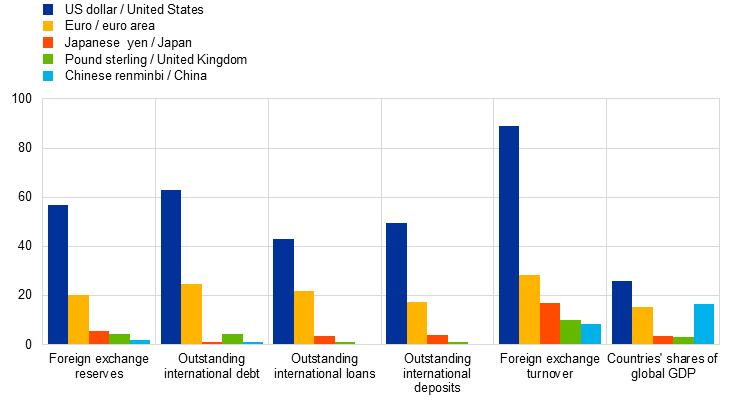
The euro remains the second most important currency in the international monetary system (Chart 2). At about 20%, the share of the euro is around 5 percentage points above the euro area’s share of global output. This shows that the euro’s international appeal exceeds the euro area’s economic weight.
Chart 2
The euro remained the second most important currency in the international monetary system
Snapshot of the international monetary system and countries’ shares of global GDP
(percentages)
Sources: BIS, IMF, Ilzetzki, Reinhart and Rogoff (2019) and ECB staff calculations.
Notes: See Chart 1 for the description of the first four indicators shown in this chart. The observations for these indicators are for the fourth quarter of 2025. Data for outstanding international loans and deposits are not available for the Chinese renminbi. Foreign exchange turnover is taken from the BIS Triennial Survey conducted in April 2025. Since transactions in foreign exchange markets always involve two currencies, foreign exchange turnover shares add up to 200%. Countries’ shares of global GDP are computed using nominal GDP data for 2025 from the IMF.
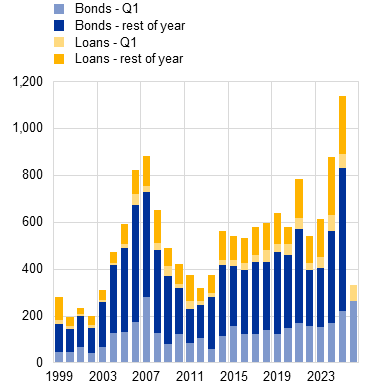
Several indicators point to growth in the international appeal of the euro in 2025. One such indicator is the issuance of international debt denominated in euro, which reached record highs during the year (Section 1.3). The issuance of international loans and bonds in euro increased by around 30% compared with 2024, surpassing USD 1.1 trillion (almost €1 trillion), which is the highest level since the euro’s inception. Bond issuance in euro – including bonds issued by US firms in a foreign currency sometimes swapped back into US dollars, also known as “Reverse Yankees” – surged by almost 50% as foreign corporates capitalised on historically tight spreads, favourable issuance cost differentials relative to other currencies and an AI-driven investment boom. The euro also became the leading currency in the green and sustainable international bond market in 2025, surpassing the US dollar for the first time, with issuances totalling almost USD 100 billion (around €85 billion).
Similarly, foreign portfolio inflows to the euro area approached historical highs in 2025. Net purchases exceeded €850 billion in 2025 – near peak levels since the creation of the euro. Equity inflows were driven by purchases of shares in investment funds, much of which is reinvested outside the euro area via funds domiciled in Ireland and Luxembourg. Their magnitude highlights the euro area’s pivotal role as a financial hub, facilitating the intermediation of global financial flows. The decline in interest rates in 2025 led to a moderate reduction in foreign inflows into euro area bonds compared with the previous year; however, these inflows remained robust by historical standards. The share of the euro in euro area cross-border liabilities has risen from 54% to 66% over the past decade, as Box 3 highlights – further testament to the growing appeal of the euro among foreign investors.
Box 2 indicates that the convenience yield – the non-pecuniary benefits earned by foreign investors on euro-denominated global safe assets – rose in 2025, reflecting the euro’s increasing global appeal. Estimates for German government bonds suggest that the convenience yield increased from nearly 60 basis points in 2023 to approximately 90 basis points in 2025.[1] However, the estimated convenience yield remained lower than that of US Treasuries, which stood at around 190 basis points in 2025, unchanged from 2024 despite the tariff announcement made by the US Administration on 2 April 2025.
Moreover, Box 1 shows that the euro behaved like a safe-haven currency during several risk-off events that marked 2025 and early 2026, prone to exchange rate fluctuations driven by sharp shifts in market sentiment. The introduction of tariffs by the US Administration on 2 April 2025 triggered elevated volatility in global financial markets and sizeable appreciations of the euro exchange rate alongside traditional safe-haven currencies such as the Swiss franc and the Japanese yen. By contrast, the US dollar exchange rate depreciated, while the yields on US Treasury bonds rose – a cross-asset correlation that is atypical for risk-off episodes. Similar patterns emerged during several risk-off events that punctuated 2025 and early 2026, for instance following the announcement that the US Department of Justice had issued subpoenas to the Federal Reserve and the US Administration’s threats to increase tariffs on European imports amid escalating tensions around Greenland. By contrast, since the outbreak of the war in the Middle East, the euro exchange rate has depreciated, partly driven by non-risk factors including an adverse terms-of-trade shock stemming from higher oil prices.
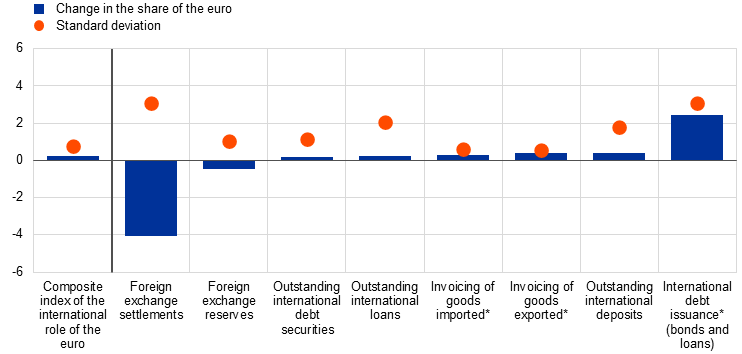
Other indicators highlight stability in the euro’s international role (Chart 3 and Table 1). For example, the share of the euro in global foreign exchange reserves remained broadly unchanged at constant exchange rates in 2025, hovering around 20% (Section 1.1). This aligns with the observation that official reserve managers tend to adjust their strategic asset allocation benchmarks infrequently. Similarly, other major reserve currencies showed limited changes: the US dollar maintained its share at approximately 57%, the Japanese yen and pound sterling remained below 6% and 5% respectively, while the Chinese renminbi held steady at close to 2%.
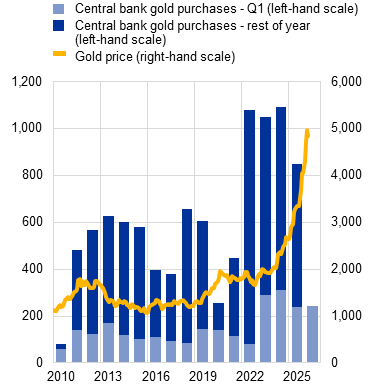
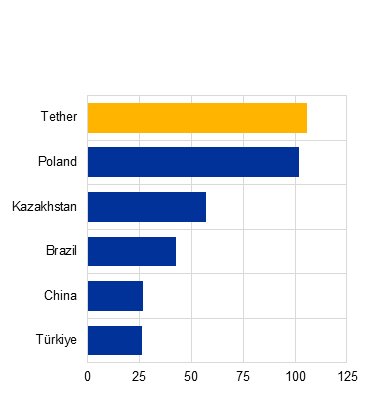
At the same time, there is no room for complacency, as persistent geopolitical tensions continued to drive strong central bank demand for gold in 2025. While central bank gold purchases decreased to around 850 tonnes in 2025, down from over 1,000 tonnes annually between 2022 and 2024, they remained higher than historical norms, despite historically high gold prices. In 2025 alone, Poland emerged as the largest official sector purchaser, acquiring around 100 tonnes, followed by Kazakhstan, Brazil, China and Türkiye. Survey evidence suggests that geopolitical risks remained a key concern for central banks, with many identifying geopolitics as one of the fastest-growing threats to their environment. Central banks with larger gold purchases also tend to be located in higher external conflict risk regions. Since Russia’s full-scale invasion of Ukraine in 2022, China has purchased over 350 tonnes of gold, followed by Poland (320 tonnes), Türkiye (220 tonnes) and India (130 tonnes). However, following the outbreak of war in the Middle East, the Turkish central bank sold or loaned out about 130 tonnes of gold – one of the largest reserve drawdowns in recent years – to defend its currency, mitigate soaring energy import costs and manage economic fallout. In 2026, besides Türkiye, other known sellers include Russia – reportedly to fund its ongoing war against Ukraine.
Chart 3
Changes in the share of the euro in various market segments in 2025
(percentage point changes at constant Q4 2025 exchange rates over the review period, unless otherwise indicated)
Sources: BIS, CLS Bank International, Dealogic, IMF, national sources and ECB staff calculations.
Notes: * Indicates percentage point change at current exchange rates. “Standard deviation” refers to the standard deviation of the annual changes in percentage points since 1999. See Chart 1 for the description of the composite index, foreign exchange settlements, foreign exchange reserves, outstanding international deposits, loans and debt securities. Invoicing of goods exported/imported are based on national sources and refer to invoicing/settlement currency in extra-euro area transactions of euro area countries. “International debt issuance” refers to international debt securities and syndicated loans issued in 2025 from Dealogic. For all indicators, see also Table 1.
In certain areas, such as global foreign exchange trading, the role of the euro declined in 2025. According to the BIS Triennial Survey conducted in April 2025, the euro was involved in about 29% of global foreign exchange transactions, a decrease of around 2 percentage points compared with the previous survey in April 2022 (Section 1.2). Similarly, the share of the euro in daily foreign exchange trading settled by CLS (continuous linked settlement) decreased by 4 percentage points between 2024 and 2025 (Chart 3 and Table 1).[2] This decline occurred alongside a surge in hedging activity against a depreciating US dollar, prompted by the announcement of reciprocal tariffs by the US Administration on 2 April 2025 – the same month the survey was conducted. Additionally, the decrease in the share of the euro in global foreign exchange transactions reflects a longer-term downward trend that began during the global financial crisis. In contrast, the share of the Chinese renminbi rose significantly, reaching almost 9% in April 2025, an increase of 1.6 percentage points compared with April 2022.
Other developments reveal further shifts in the global currency landscape, with several countries advancing tech-driven alternatives to traditional cross-border payment systems (Section 1.4). India has proposed linking the domestic central bank digital currencies (CBDCs) of BRICS countries to settle cross-border transactions. In January 2025 A7A5 – a stablecoin token pegged to the Russian rouble – was launched to facilitate financial flows in and out of Russia, which have been constrained by international sanctions. On 1 February 2026 President Xi Jinping called for the renminbi to become a global reserve currency, in one of his clearest statements yet of China’s ambition to strengthen the international role of its currency. For instance, China’s digital yuan (the e-CNY) remains the dominant currency in project mBridge – a multi-CBDC platform designed to settle cross-border payments among China, Hong Kong, Thailand, the United Arab Emirates and Saudi Arabia. Settlement activity on China’s Cross-Border Interbank Payment System (CIPS) increased by more than one-third in the days surrounding the outbreak of the war in the Middle East. Industry experts have suggested that the conflict could serve as a catalyst for an expansion of the renminbi’s role in the global oil markets. Notably, reports indicate that some ships made payments in renminbi via CIPS or in crypto-assets to transit through the Strait of Hormuz in March and April 2026.
Shifts in the global geopolitical landscape underscore the importance of a stronger international role for the euro. There is an opening for the euro to enhance its global appeal – provided that European policymakers create the necessary conditions and put words into action without delay.[3] The euro’s full global potential continues to rest on three key pillars: economic resilience, legal and institutional integrity and geopolitical credibility. These pillars must be reinforced. Indeed, at the Euro Summit on 19 March 2026 euro area leaders stressed that “the euro’s position on the global stage will depend on Europe’s economic and geopolitical strength, as well as the EU remaining a reliable and predictable international partner in the new geopolitical context”.[4]
In particular, completing the Single Market remains essential to unlocking Europe’s full potential. Moreover, for the euro to evolve into a truly global international currency, the euro area must build scale and deeper, more liquid capital markets. This would enable the euro to attract capital inflows based on its own merits and ensure that these inflows can be smoothly redirected into productive investments. Therefore, the euro area must integrate and deepen its capital markets, taking concrete steps towards completing the savings and investments union, for which an ambitious timetable remains critical. Additional steps like joint financing of public goods would help establish a safe and liquid pool of EU public debt. Finally, safeguarding investors’ trust in the institutions and policies that underpin the euro, including by upholding the rule of law, remains crucial to its global appeal.
The ECB plays a role in underpinning the euro’s global appeal in three ways.
First, as a pillar of Europe’s institutional strength. The ECB’s independence and price stability mandate reinforce investor confidence in the euro. It ensures stability and predictable policies – a key comparative advantage Europe can leverage.
Second, as the issuer of a currency designed for the digital payment age. On 31 March 2026 the Eurosystem outlined its comprehensive payment strategy covering wholesale, business-to-business, retail and cross-border transactions, aiming to ensure that central bank money remains a trusted anchor of stability amid rapid technological change, bolstering the euro’s global appeal.[5] In particular, subject to the adoption of the necessary legal acts by European co-legislators, the ECB is preparing for the potential issuance of a digital euro, which will help safeguard Europe’s monetary sovereignty in a digital world. At the wholesale level, the Eurosystem’s Pontes initiative will connect TARGET services to distributed ledger technology (DLT) platforms, enabling settlement of DLT-based wholesale financial transactions in central bank money by the third quarter of 2026. Meanwhile, project Appia aims to develop Europe’s next-generation financial infrastructure, enhancing the efficiency of the European financial markets and boosting the euro’s global appeal. Additionally, the Eurosystem is working to link its fast payment system (TIPS) with key global partners to improve cross-border payment systems involving the euro and other currencies, including a connection with India by 2027, with similar plans being explored for Switzerland, Brazil and Nexus Global Payments.[6]
Thirdly, as a provider of backstop liquidity to central banks abroad. The ECB expanded its EUREP facility on 14 February 2026.[7] The enhanced facility provides permanence: central banks outside the euro area can now rely on continuous access to liquidity in euro, not just temporary lines. It extends scope, with the facility moving from a regional to a global perimeter where any central bank that meets the basic criteria can request access, with flexibility on usage. It also ensures agility: access is granted by default unless there is a reason to restrict it, such as money laundering, terrorism financing or international sanctions, speeding up the provision of liquidity. The availability of a lender of last resort for central banks worldwide boosts market participants’ confidence to invest, borrow and trade in euro globally, knowing that access will be there during market disruptions.
Table 1
The international role of the euro from different perspectives
Summary of data in this report
Indicator |
Share of the euro |
Global outstanding amounts |
||||
|---|---|---|---|---|---|---|
Latest |
Comparison period |
Difference |
Latest |
Comparison period |
Difference |
|
Global foreign exchange reserves |
20.2 |
20.7 |
-0.5 |
13,137 |
12,330 |
6.5 |
Outstanding international debt securities: narrow measure, i.e. excluding home currency issuance |
24.6 |
24.5 |
0.2 |
21,694 |
19,230 |
12.8 |
Outstanding international loans: by banks outside the euro area to borrowers outside the euro area |
21.7 |
21.5 |
0.2 |
3,310 |
2,892 |
14.5 |
Outstanding international deposits: with banks outside the euro area from creditors outside the euro area |
17.3 |
16.8 |
0.4 |
3,581 |
3,235 |
10.7 |
Foreign currency-denominated bond issuance, at current exchange rates |
31.1 |
25.6 |
5.5 |
2,678 |
2,208 |
21.3 |
Euro nominal effective exchange rate (broad measure against 41 trading partners) |
131.1 |
122.8 |
8.3 |
|||
Daily foreign exchange trading (settled by CLS), as a percentage of foreign exchange settlement |
32.2 |
36.3 |
-4.1 |
|||
Invoicing of goods exported from the euro area to non-euro area countries, at current exchange rates |
60.0 |
59.6 |
0.4 |
|||
Invoicing of goods imported into the euro area from non-euro area countries, at current exchange rates |
53.1 |
52.8 |
0.3 |
|||
Sources: BIS, CLS Bank International, Dealogic, IMF, national sources and ECB staff calculations.
Notes: An increase in the euro nominal effective exchange rate indicates an appreciation of the euro. For foreign exchange trading, currency shares add up to 200% because transactions always involve two currencies
1.1 Use of the euro as an international reserve currency
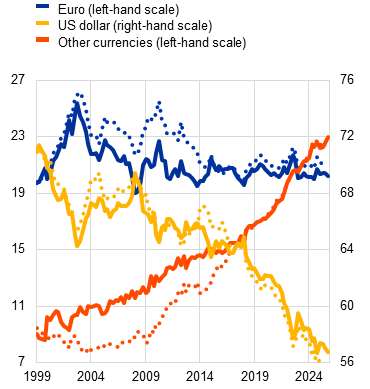
In 2025 the share of the euro in global official foreign exchange reserves remained broadly stable at constant exchange rates, hovering around 20% (Chart 4, panel a). Meanwhile, the US dollar’s share remained similarly stable, at about 57%. In the third quarter of 2025, the IMF refined its methodology for calculating currency shares. The COFER dataset – the main public source of information on the currency composition of countries’ official foreign exchange reserves aggregated at the global level – no longer includes an unallocated component. Instead, IMF staff impute this portion to produce currency compositions, in both dollar terms and shares, that sum to 100% of global foreign exchange reserves.[8] This revision significantly affected the “other currencies” category, causing its share to increase, particularly during the period between 2000 and 2018 (solid lines show the new time series). On the other hand, the euro’s share was revised downwards, with a decrease of around 0.8 percentage points in mid-2025 compared with the previous time series.
Chart 4
Stable currency shares in global foreign exchange reserves in 2025 at constant exchange rates; euro rise at market prices mainly driven by exchange rate effects
a) Shares of the euro and US dollar in global foreign exchange reserves |
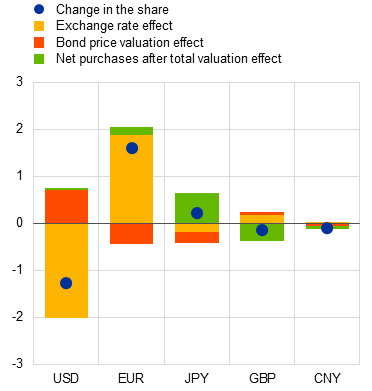
b) Decomposition of changes in the share of the main reserve currencies in 2025 |
|---|---|
(percentages; at constant Q4 2025 exchange rates) |
(percentage points at current exchange rates and percentage point contributions) |
 |
 |
Sources: IMF, LSEG and ECB staff calculations.
Notes: In panel a) the latest observations are for the fourth quarter of 2025. Solid lines refer to the currency shares based on a new methodology adopted by IMF staff from the third quarter of 2025 which imputes the currency composition of unallocated reserves. Dotted lines represent the previously published series based on non-imputed allocated reserves. In panel b), the changes in the share of each currency are calculated from foreign exchange reserves with disclosed currency denomination only. The valuation effect for currency between period and can be expressed as: where is reserve assets held, is the bilateral exchange rate against the US dollar, is the share of reserves held as securities and is the average total return on the security portfolio between periods and . Subtracting this value from the actual change in the level of reserve assets gives the approximate net purchases in period t.
Developments in other reserve currencies were similarly stable. The shares of the Japanese yen and pound sterling remained below 6% and 5% respectively, while the share of the Chinese renminbi stayed close to 2%. These developments suggest that China’s currency’s role as an official store of value is limited at the current juncture.
At market prices, euro-denominated reserve holdings increased in 2025, largely driven by the euro’s exchange rate appreciation (Chart 4, panel b). Specifically, the euro’s exchange rate appreciation against the US dollar almost entirely explains the 1.6 percentage point increase in the euro’s share in foreign exchange reserves at market prices. On the other hand, the combined contributions of purchases by reserve managers and negative bond valuation effects were marginal. For the US dollar, exchange rate and bond valuation effects had the opposite effect, while purchases by reserve managers had a negligible contribution. Official reserve managers were net purchasers of Japanese yen-denominated assets – in the wake of a doubling in long-term yields on Japanese government bonds in the review period, from 1% to 2% – but were net sellers of pound sterling-denominated assets. Their positions in Chinese renminbi remained unchanged.
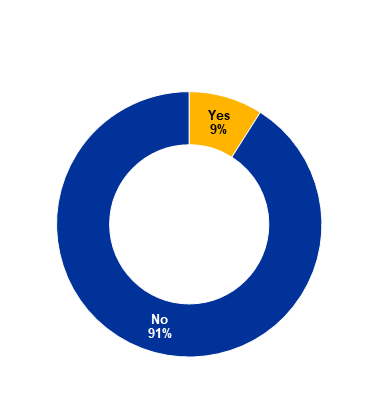
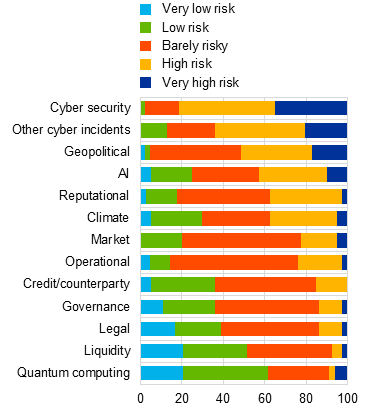
Broadly stable reserve currency shares reflect official reserve managers’ traditionally prudent approach of avoiding abrupt changes to strategic investment benchmarks, even amid heightened geopolitical uncertainty. In line with this interpretation, a striking result from a recent survey showed that over two-thirds of central banks that incorporated geopolitical risks into their reserve management made no changes in the currencies they invested in.[9] Fewer than 10% of central bank reserve managers cited US tariffs as a factor impacting their reserve allocations in mid-2025 (Chart 5, panel a). Recent market analysis suggests that China – the world’s largest official reserve holder – has, in fact, continued to accumulate US dollars.[10] At the same time, towards the end of 2025 central banks identified geopolitics as the third most significant risk they faced, ranking behind cybersecurity and other cyber incidents (Chart 5, panel b). Geopolitics was also considered the fastest-growing threat in 2025, with three-quarters of central banks indicating an increase over the past year.[11]
The war in the Middle East has heightened concerns about geopolitics. In a survey of central banks published in early April 2026, 70% of respondents cited geopolitics as the most significant risk they faced in 2026.[12] Almost 80% said they had incorporated geopolitical risk into their strategies, while 30% viewed geopolitics as the most important factor affecting their reserve management over the next five years.
Chart 5
Geopolitical risks remain key factor monitored by official reserve managers
Sources: Koroes, L., Asaju, T. and Hinge, D., Risk Management Benchmarks 2025 – tariff realignment? and Risk Management Benchmarks 2026 report – tracking op risk, Central Banking.
Notes: Responses were collected via two surveys, the first conducted between June and September 2025 with 81 central banks participating and the second conducted between October and December 2025 with 48 central banks participating.
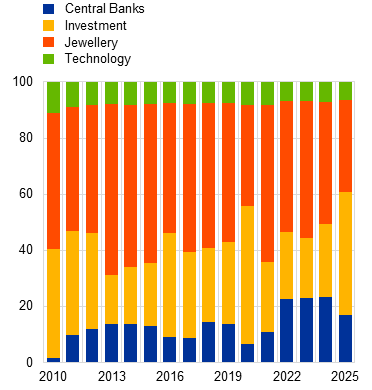
Central bank gold purchases slowed in 2025, partly reflecting historically high gold prices and strong private investor demand, but remained elevated. Gold purchases by central banks eased to around 850 tonnes, from over 1,000 tonnes per year between 2022 and 2024 (Chart 6, panel a). The soaring prices and rising value of existing holdings likely curbed demand for additional purchases by the official sector. At the same time, gold purchases by central banks remained much stronger than in the period preceding Russia’s full-scale invasion of Ukraine. Private investment demand for gold reached nearly 2,200 tonnes in 2025 – almost double the 2024 figure and accounting for nearly 50% of global gold demand (Chart 6, panel b). Investment demand was fuelled by a record USD 89 billion in inflows into gold-backed exchange-traded funds, which purchased approximately 800 tonnes of gold in 2025.
Chart 6
Central bank gold buying softened, amid soaring prices and strong private investor demand
a) Central bank gold purchases and price of gold |
b) Gold demand by sector |
|---|---|
(tonnes, US dollars per troy ounce) |
(percentages) |
 |
 |
Sources: IMF, World Gold Council and ECB staff calculations.
Note: In panel a) the latest observations are for the first quarter of 2026. One troy ounce equals approximately 31.10 grams. In panel b), the latest observations are for the end of 2025. “Jewellery” denotes gold purchases driven by consumption for making gold jewellery. “Investment” refers to purchases of gold bars, coins and exchange-traded funds. “Technology” denotes gold used in industrial applications. “Central banks” denotes net purchases by central banks and selected international financial institutions such as the IMF or the BIS (for further details see the guidance note published by the World Gold Council in 2018).
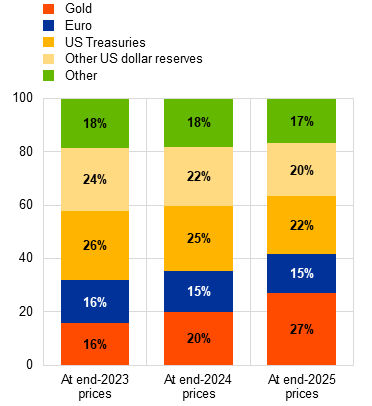
The share of gold in total official foreign reserves – comprising both foreign exchange and gold holdings – had increased to 27% at the end of 2025 (Chart 7, panel a). The share of gold now surpasses both that of the euro (15%) and US Treasuries (22%). However, this development largely reflects valuation effects. In nominal terms, the gold price surged by around 60% and 30% in 2025 and 2024 respectively, which mechanically increases the share of gold in total official foreign reserves. Correcting for such valuation effects by using the gold price at the end of 2023, the share of the euro (16%) remains at par with the share of gold (16%), while the share of US Treasuries continues to be markedly higher (26%). Going forward, gold faces limitations as an official reserve asset compared with the major fiat currencies: its price is volatile, it is not remunerated and, when held in physical form, it is costly to store. More importantly, the supply of gold is not fully elastic and does not adjust seamlessly to shifts in international demand for liquidity.
Chart 7
Rising prices boost gold’s share in global foreign reserves
a) Shares of the euro, US Treasuries and gold in official reserves at the end of 2025 at different gold prices |
b) Top five official sector gold purchasers and Tether’s gold purchases in 2025 |
|---|---|
(percentages) |
(tonnes) |
 |
 |
Sources: Tether auditors’ reports, IMF, World Gold Council and ECB staff calculations.
Notes: The latest observations are for the end of 2025. In panel a) the datasets for gold reserves and official foreign exchange reserves differ, resulting in varying country coverage. In panel b) the data for Türkiye reflect changes in official sector gold holdings, excluding gold deposited by domestic commercial banks at the central bank as part of their reserve requirements, as reported by the World Gold Council.
However, gold purchases may also reflect efforts by some central banks to strengthen balance sheet resilience amid rising geopolitical risks. Survey data suggest that central banks hold gold not only for diversification but also as a hedge against geopolitical risk.[13] Central banks with larger gold purchases also tend to be located in higher external conflict risk regions (Figure 1). Since Russia’s full-scale invasion of Ukraine in 2022, China has purchased over 350 tonnes, followed by Poland (320 tonnes), Türkiye (220 tonnes) and India (130 tonnes). Moreover, Poland – with around 100 tonnes – remained the largest official sector purchaser in 2025, followed by Kazakhstan, Brazil, China and Türkiye (Chart 7, panel b).[14] Interestingly, the largest stablecoin issuer, Tether, was an even larger purchaser of gold in 2025, with more than 100 tonnes, underscoring the potentially relevant macroeconomic implications that stablecoins could have globally if they continue to expand (Section 1.4).
Following the outbreak of war in the Middle East, some central banks, however, sold gold and US Treasuries to support their economies and currencies. The Turkish central bank sold or loaned out about 130 tonnes of gold – one of the largest reserve drawdowns in recent years – to defend its currency, mitigate soaring energy import costs and manage economic fallout.[15] In 2026, besides Türkiye, other known sellers include Russia – reportedly to fund its ongoing war against Ukraine.[16] In addition, the value of US Treasuries held in custody at the New York Federal Reserve by official institutions – a group largely made up of central banks – dropped by USD 82 billion to USD 2.7 trillion in March 2026 – the lowest level since 2012.[17]
Figure 1
Geopolitical considerations influence central banks’ decisions to purchase gold
Major central bank gold buyers and external conflict risk between 2022 and 2025
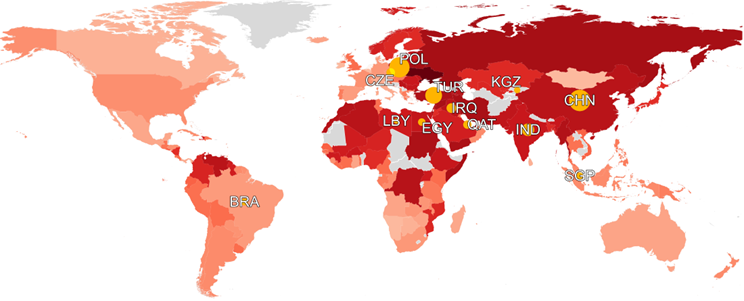
Sources: PRS Group, World Gold Council and ECB staff calculations.
Notes: The yellow bubbles indicate central banks whose gold purchases exceeded 10 tonnes between 2022 and 2025, with bubble size proportional to the volume purchased. Countries are coloured based on their average PRS external conflict risk rating over the same period, capturing exposure to war, cross-border conflict and foreign pressures. Darker red indicates higher external conflict risk. The estimated risk for all top five gold purchasers (China, Poland, Türkiye, India and Iraq) exceeds the global risk average. The boundaries, colours, denominations and any other information shown on the maps do not imply, on the part of the ECB or the Eurosystem, any judgement on the legal status of any territory or any endorsement or acceptance of such boundaries.
1.2 Use of the euro in global foreign exchange markets
The euro remains the second most actively traded currency in global foreign exchange markets, but its share has been declining (Chart 8). According to the latest Triennial Central Bank Survey of foreign exchange and over-the-counter (OTC) derivatives markets conducted by the BIS in April 2025, the euro was involved in 28.5% of all foreign exchange trades, remaining the second most traded currency after the US dollar (Chart 8, panel a). However, its share has trended downward since 2010 and also fell by around 2 and 4 percentage points compared with the previous surveys carried out in 2022 and 2019 respectively, reflecting the rising importance of other currencies (Chart 8, panel b).[18] Notably, the Chinese renminbi recorded the largest increase in market share since 2022, reaching 9% in 2025.[19] The US dollar retained its dominant position, appearing on one side of almost 90% of total OTC transactions – a share that has remained broadly stable across the three most recent surveys.
Hedging activity, driven by the depreciation of the US dollar that followed the imposition of unilateral tariffs by the US Administration, boosted foreign exchange trading in April 2025, when the latest BIS Triennial Survey was conducted. Compared with the 2022 survey, global foreign exchange turnover rose by 27%, reaching USD 9.5 trillion per day in April 2025. However, a significant portion of this increase – approximately USD 1.5 trillion – was linked to heightened market volatility, triggered by the US Administration’s tariff announcement on 2 April and the unexpected sharp depreciation of the US dollar that followed. Some investors, including equity investors, many of whom were underhedged owing to the elevated hedging costs that followed global monetary policy tightening from 2022, rushed to adjust foreign currency exposures and hedge against dollar risk.[20] In turn, knock-on volatility and movements in exchange rates triggered speculative trading by hedge funds and momentum traders. Spot and forward trading in particular surged by 42% and 51% respectively, as these instruments were widely used for rebalancing portfolios and managing currency risk.[21]
Chart 8
Euro is the second most traded currency in global foreign exchange markets, although its share is declining
a) Share of the euro in global OTC foreign exchange transactions, on a net-net basis |
b) Share of selected currencies in global OTC foreign exchange transactions, on a net-net basis |
|---|---|
(percentages) |
(percentages) |
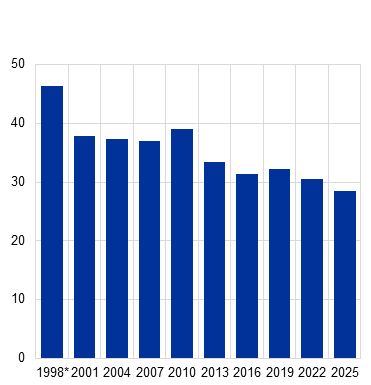 |
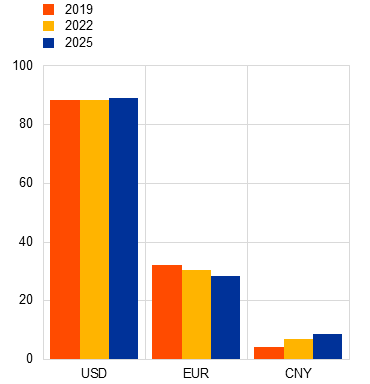 |
Sources: BIS and ECB staff calculations.
Notes: As two currencies are involved in each transaction, the sum of the percentage shares of individual currencies totals 200% instead of 100%. Shares are adjusted for local and cross-border inter-dealer double-counting (i.e. expressed on a “net-net” basis). In panel a), the value for 1998 (denoted by *) is computed by aggregating the transactions for the 11 euro legacy currencies net of intra-currency trading; see Detken, C. and Hartmann, P., “Features of the euro's role in international financial markets”, Economic Policy, Vol. 17, 2002. Panel b) does not show the shares of the Japanese yen and the pound sterling, although they were higher than that of the Chinese renminbi in 2025.
Foreign exchange trading activity involving the euro remains particularly significant within the euro area and its neighbouring regions, especially the United Kingdom. The United Kingdom, including the City of London, continues to serve as the world’s leading hub for foreign exchange trading. In 2025 over 43% of total euro trades were initiated in the United Kingdom, which is about 5 percentage points higher than the share of all-currency trading conducted there (Chart 9). The euro area accounted for 17% of total euro trades in 2025 – double its share of trading in all currencies. Conversely, Asian trading hubs such as Singapore and Hong Kong represented just 8% of total euro trades, which is half their share of trading in all currencies. This relatively limited role of Asian trading hubs – a distinctive feature of the euro compared with the US dollar, where their share is about 20% – highlights the more regional nature of foreign exchange trading in euro in contrast with the more globally distributed trading of US dollars.
Chart 9
Foreign exchange trading activity involving the euro remains particularly significant within the euro area and its neighbouring regions
Location of foreign exchange trading
(percentages)
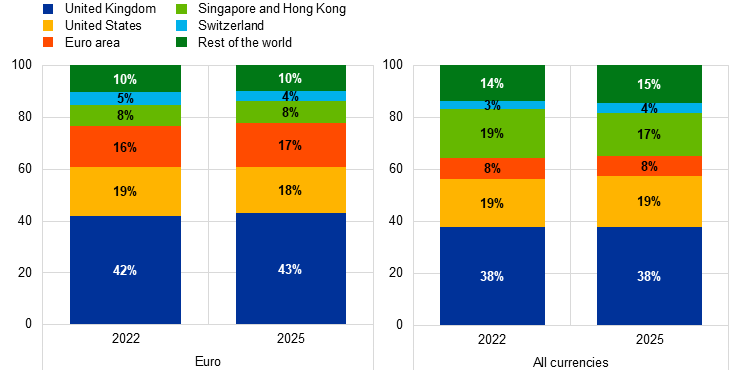
Sources: BIS and ECB staff calculations.
Notes: The data on geographical locations include spot transactions, outright forwards, foreign exchange swaps, currency swaps, options and other products. They are adjusted for local inter-dealer double-counting (i.e. on a net-gross basis) and may differ slightly from national survey data owing to differences in aggregation procedures and rounding. The BIS uses several criteria to determine the location of a foreign exchange transaction, notably the location of the initiating sales desk.
1.3 Use of the euro in international finance
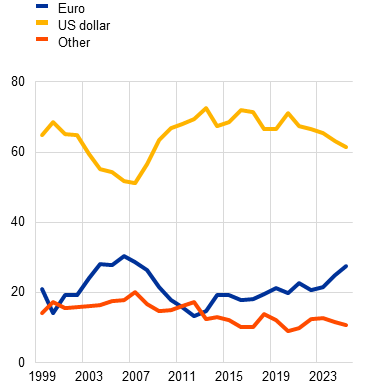
The euro reached a record high as a currency of issuance for foreign currency-denominated debt in 2025. International issuance in euro for debt financing – including both bonds and loans – rose by around 30% compared with 2024, surpassing USD 1.1 trillion, the highest level since the euro’s inception (Chart 10, panel a). This increase was driven by strong euro-denominated international bond issuance, which grew by almost 50%, while loan issuance declined slightly. The overall share of euro-denominated bond and loan issuance rose by more than 2 percentage points to almost 30% (Chart 10, panel b). Concurrently, the share of the US dollar fell to around 60%, while the share of other currencies saw a marginal decrease.
Chart 10
The share of the euro in issuance of foreign currency-denominated bonds and loans increased in 2025, driven by record-high euro-denominated bond issuance
a) Total issuance volume of international bonds and loans denominated in euro |
b) Currency composition of foreign currency-denominated bond and loan issuance (shares) |
|---|---|
(USD billions) |
(percentages) |
 |
 |
Sources: Dealogic and ECB staff calculations.
Notes: The latest observations are for the first quarter of 2026 for panel a) and for the end of 2025 for panel b). Loans refer to syndicated cross-border loans issued in euro to borrowers outside the euro area.
The increase in the euro’s share in foreign currency-denominated debt issuance was driven by strong corporate bond activity. In 2025 international euro-denominated bond issuance surged as corporates capitalised on historically tight corporate spreads, favourable cost differentials and an AI-driven investment boom. Alphabet, a US-based multinational tech conglomerate and parent company of Google, issued its first euro-denominated foreign bonds, raising around €13 billion across two deals, making it the largest international bond issuer in euro last year (Table 2). The two deals accounted for 40% of Alphabet’s 2025 overall bond issuance, supporting its commitment to invest €5.5 billion in Germany through 2029 and €5.0 billion in Belgium through 2027, and to continue its investment in France and the Nordic countries. Most of Alphabet’s recent European investments focus on AI infrastructure, cloud computing capacity and data-centre expansion, reflecting the surge in demand for generative AI and cloud services. In the first quarter of 2026, the trend of strong euro-denominated issuance continued, including a record issuance of €14.5 billion by the US global technology company Amazon to finance its vast AI investments.
The euro became the leading currency in the green and sustainable international bond market in 2025, surpassing the US dollar for the first time (Chart 11, panel a). Issuance of offshore green and sustainable bonds denominated in euro rose to almost USD 100 billion, up from around USD 90 billion in 2024, increasing the euro’s share from around 35% to over 41%. Meanwhile, US dollar-denominated issuance in this market declined by USD 30 billion, reducing the US dollar market share by 10 percentage points to around 32%. The share of issues in other currencies – such as the pound sterling and Australian dollar – grew by 13%, to stand at 26%. International CNY-denominated issuance in this market remains limited, at less than USD 3 billion. China’s green bond market has grown rapidly, spurred on by President Xi Jinping’s 2020 pledge to cap carbon emissions by 2030 and achieve carbon neutrality by 2060 (“30·60 targets”). However, over 95% of CNY-denominated green bonds are still issued domestically.
Europe’s leadership in sustainable finance and green bonds presents an opportunity to expand the global use of the euro. While only around 10% of total international euro-denominated bond issuance was classified as green or sustainable, this market segment saw fast growth, supported by EU initiatives such as European Green Bond (EuGB) and Next Generation EU (NGEU), as well as the ongoing maturation of the market.[22] Moreover, some proposals suggest that Europe could start invoicing climate-friendly products – such as decarbonised energy equipment, electric vehicles and commodities essential for electrification – in euro. This could go hand in hand with the development of corresponding financial instruments, such as those designed to hedge climate-related risk.[23],[24] The recently adopted EU Omnibus I Sustainability Package may further support green and sustainable bond issuance going forward.[25]
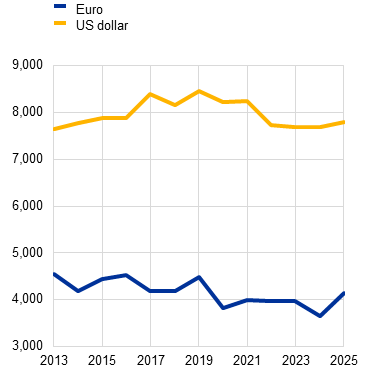
Chart 11
Euro surpassed the US dollar in international green and sustainable bonds, while international issues in euro remain concentrated in geographically close countries
a) Currency composition of green and sustainable international bond issuance |
b) Average distance of country of origin of international bonds, weighted by issuance volumes |
|---|---|
(USD billions) |
(kilometres) |
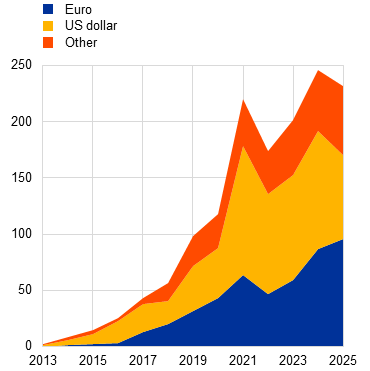 |
 |
Sources: Dealogic, CEPII and ECB staff calculations.
Notes: The latest observations are for the end of 2025. Panel a) shows the yearly issued amount of international green and sustainable bonds by currency, i.e. green and sustainable bonds whose denomination is different from the issuer’s domestic currency. Panel b) shows the average distance between the most populated city of an international bond issuer’s country and Brussels (for the euro) or New York City (for the US dollar), weighted by issuance volumes.
Overall, euro-denominated international debt issuance saw broad-based growth, with notable increases in the United States and emerging markets. The United Kingdom remained the largest jurisdiction, accounting for 27% of euro-denominated bond issuance, while the United States significantly increased its share to nearly 25%, driven by the AI investment boom. Bonds issued by US firms in a foreign currency, sometimes swapped back into US dollars, are known as “Reverse Yankees” in market parlance.[26] Emerging market countries also expanded their euro issuance, with their share rising by 3 percentage points to 8%, led by sovereign debt issuances from Mexico, Colombia and China (Table 2). Despite this, the average geographical distance of euro-denominated debt issuers remained around 4,000 km – about half that of US dollar issuers (around 8,000 km) – highlighting the US dollar’s broader global reach (Chart 11, panel b).
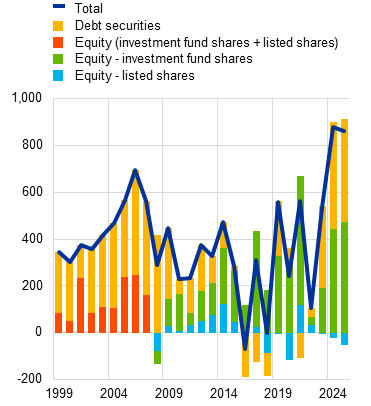
Turning to portfolio inflows, foreign investors purchased euro area equity and debt in volumes close to historical highs in 2025. Net purchases exceeded €850 billion in 2025 – near peak levels since the creation of the euro (Chart 12, panel a). Equity inflows were driven by purchases of shares in investment funds, which rose to around €470 billion in 2025, up from around €440 billion in 2024. A substantial portion of these portfolio inflows – typically around three-quarters – is reinvested outside the euro area via investment funds based in Ireland and Luxembourg. Their magnitude highlights the euro area’s pivotal role as a financial hub, facilitating the intermediation of global financial flows.[27] The decline in interest rates in 2025 led to a moderate reduction in foreign inflows into euro area bonds compared with the previous year. However, these inflows remained robust by historical standards, with net debt purchases totalling around €440 billion in 2025. Taking a longer-term perspective, Box 3 presents new indicators on the currency composition of the euro area international investment position over the past decade, pointing to the growing role of the euro in foreign portfolio investment in the euro area.
Chart 12
Significant foreign portfolio inflows to the euro area, accompanied by strong flows to euro area corporates from private market funds
a) Net purchases of euro area portfolio debt and equity by foreign investors |
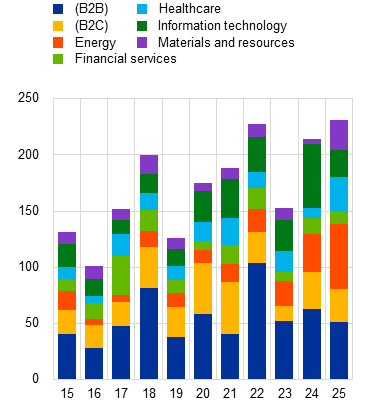
b) Sector breakdown of global private equity and credit provided to euro area corporates by funds |
|---|---|
(EUR billions) |
(EUR billions) |
 |
 |
Sources: ECB, PitchBook Data Inc. and ECB staff calculations.
Note: The latest observations are for 2025. In panel a) the breakdown of portfolio equity into listed shares and investment fund shares is only available from 2008. Panel b) uses the top level of PitchBook’s proprietary industry classification system, which assigns each company one primary industry that best reflects its main line of business. “B2C” stands for business-to-customer and represents consumer products and services such as consumer (non-) durables or retail and e-commerce. “B2B” stands for business-to-business and represents business products and services, such as commercial products, services, transportation including aerospace and defence or industrial equipment.
Euro area corporates also received ample funding from global private market funds in 2025 (Chart 12, panel b). Private market funds are increasingly relevant for corporate financing in the euro area, complementing bank lending and public markets.[28] In 2025 total private credit extended to euro area projects increased to €230 billion, up 10% from 2024 and 50% from 2023. Global market funds increasingly channelled capital into materials and resources, healthcare and the energy sector – boosting inflows by around 500%, 250% and 70% respectively in 2025. At the same time, inflows into the IT sector fell by 60% compared with 2024. This move has boosted European markets, with their heavy weighting towards “old economy” sectors such as manufacturing, which is most commonly aligned with materials and resources, and energy.[29] Moreover, investors have seized on signs that the historic defence spending spree announced in March 2025 is feeding through to the industry. Private credit funds often finance riskier ventures like start-ups, and can thus raise financial stability concerns, though Europe’s relatively stringent regulation and small market size tend to mitigate such concerns.[30]
Table 2
Top 20 euro-denominated international bond issuers in 2025
Issuer |
Deal nationality |
Issuer type (sector) |
Total EUR value issued in 2025 (EUR billions) |
|---|---|---|---|
Alphabet Inc |
USA |
Corporate (technology) |
13.25 |
Romania |
Romania |
Sovereign |
11.95 |
Novo Nordisk Finance (Netherlands) BV |
Denmark |
Corporate (healthcare) |
10.00 |
International Development Association - IDA |
USA |
Supranational |
9.25 |
Bank of America Corp |
USA |
Corporate (financial services) |
9.00 |
Morgan Stanley |
USA |
Corporate (financial services) |
8.5 |
Nationwide Building Society |
UK |
Corporate (financial services) |
7.65 |
Mexico |
Mexico |
Sovereign |
7.40 |
Bulgaria |
Bulgaria |
Sovereign |
7.20 |
UBS Group AG |
Switzerland |
Corporate (financial services) |
6.75 |
International Bank for Reconstruction and Development |
USA |
Supranational |
6.58 |
Citigroup |
USA |
Corporate (financial services) |
6.15 |
Poland |
Poland |
Sovereign |
6.00 |
NatWest Markets |
UK |
Corporate (financial services) |
5.85 |
Barclays plc |
UK |
Corporate (financial services) |
5.75 |
RBC |
Canada |
Corporate (financial services) |
5.50 |
NTT Finance Corp |
Japan |
Corporate (financial services) |
5.50 |
TD Bank Group |
Canada |
Corporate (financial services) |
5.50 |
HSBC Holdings plc |
UK |
Corporate (financial services) |
5.50 |
Goldman Sachs Group Inc |
USA |
Corporate (financial services) |
5.25 |
Sources: Dealogic and ECB staff calculations.
Note: Based on bonds issued in 2025.
1.4 Use of the euro in international payments and trade
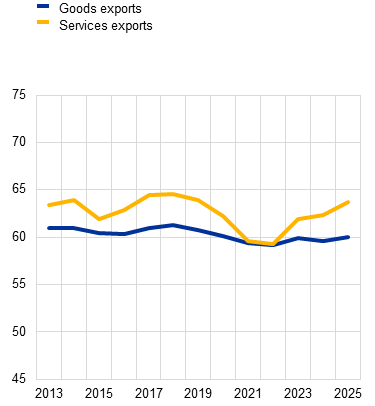
The role of the euro for invoicing euro area external trade remained stable in 2025. Use of a currency for invoicing international trade is an important indicator of its international role, as widespread use amplifies its influence on global trade, pricing and finance, according to research.[31] Here, the evidence points to continued stability in the euro’s global appeal. For instance, the share of the euro as an invoicing currency for euro area exports outside the euro area remained stable in 2025, accounting for almost 60% of goods exports and around 64% of services exports (Chart 13, panel a).[32]
Chart 13
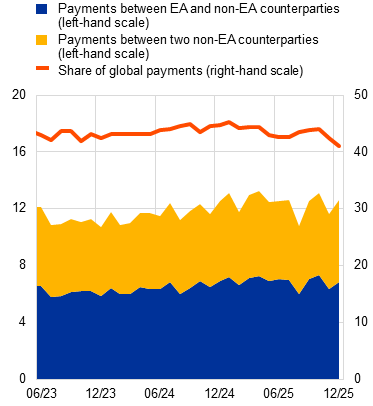
Euro’s role in euro area export invoicing and global payments broadly stable in 2025
a) Euro share in invoicing of exports outside the euro area |
b) Global payments in T2 |
|---|---|
(percentages) |
(left-hand scale: EUR trillions; right-hand scale: percentages, monthly totals) |
 |
 |
Sources: National central banks, T2 and ECB staff calculations.
Notes: The latest observations are for the end of 2025. In panel a), the euro area aggregate is based on a sub-group of euro area countries for which data are available (Belgium, Estonia, Greece, France, Latvia, Lithuania, Portugal and Slovakia) and weighted by export volumes. See also Table A8 in the statistical annex to this report. In panel b) global payments are computed relative to the universe of interbank and retail (customer) payments in T2. “Payments between EA and non-EA counterparties” are payments where the instructing bank or the beneficiary bank is located in the euro area and the counterparty outside the euro area. “Payments between non-EA counterparties” are payments where both the instructing bank and the beneficiary bank are located outside the euro area.
Furthermore, the available evidence regarding the euro’s global role as a settlement currency – serving as the final medium of payment to clear obligations between parties – also indicates broad stability in 2025. Global payments settled through the T2 platform – i.e. payments where at least one bank is located outside of the euro area – were also broadly comparable to those in previous years. In 2025 they made up over 40% of interbank and retail payments in T2, the Eurosystem’s gross settlement system for high value payments in central bank money (Chart 13, panel b). This was the case for payments where both the beneficiary and instructing banks were located outside the euro area (with monthly totals of around €5.5 trillion) and payments where a non-euro area bank participated in only one leg of the transaction (with monthly totals of around €7 trillion).[33] Similarly, the share of the euro in Swift messages – standardised financial messages exchanged between banks via the Swift network to securely transmit payment and transaction details – remained at around 23%, close to 2024 levels. The shares of the US dollar and Chinese renminbi stood at around 48% and 4% respectively. Finally, focusing on the evidence regarding the international use of euro cash, the purchases and sales of euro banknotes from and to destinations outside the euro area increased by almost 10% in 2025 compared with 2024. The use of euro banknotes outside the euro area remained concentrated mostly in the euro area neighbourhood.[34]
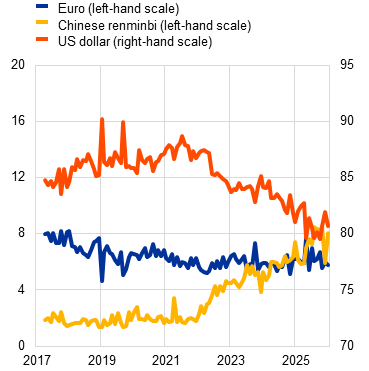
Similarly, the euro’s share in the global trade finance market remained stable in the review period, while the share of other currencies continued to shift noticeably (Chart 14, panel a). Trade finance includes financial products and services that banks and other institutions provide to facilitate international trade, helping importers and exporters to manage risks, access financing and bridge timing gaps between shipment and payment, and ensuring that both sides of a transaction are protected. In this market, the euro continued to account for around 6% of global trade finance messages in Swift, broadly unchanged from previous years.[35] At the same time, the share of the Chinese renminbi continued to increase rapidly, from 5.5% in 2024 to around 8% in March 2026, up by about 6 percentage points compared with pre-pandemic levels. Meanwhile, the US dollar’s share decreased by more than 2 percentage points between 2024 and March 2026 to around 81%, broadly mirroring the renminbi’s rise, and declining by around 6 percentage points since the pandemic. Overall, the share of the Chinese renminbi now surpasses that of the euro, aligning with the export boom China has seen since the pandemic and the relentless increase in its external trade surplus, despite the imposition of reciprocal tariffs by the US Administration in April 2025.[36]
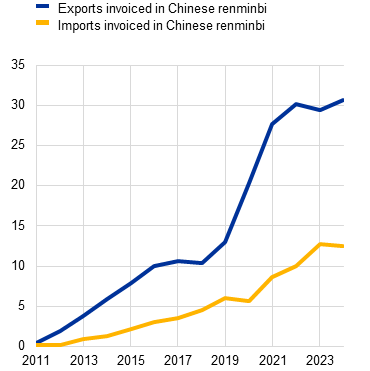
The use of the renminbi for trade invoicing with China has surged in recent years in certain cases. However, as a whole, the renminbi’s share as an invoicing currency for euro area trade with countries outside the EU remains modest, accounting for around 2% in 2024.[37] Recent research using firm-level customs data, which provide insights into patterns by source and destination countries, indicates that the use of the renminbi in trade with China has grown significantly over time. For example, the share of renminbi invoicing in French exports to China increased from approximately 10% in 2018 to around 30% in 2024, while its share in imports rose from about 6% to roughly 12% during the same period (Chart 14, panel b).[38]
Chart 14
Rising role of the renminbi in global trade finance and, in some cases, invoicing of international trade
a) Shares of top three currencies in Swift trade finance messages |
b) Chinese renminbi share of French trade with China |
|---|---|
(percentages) |
(percentages) |
 |
 |
Sources: Swift RMB Tracker and Berthou and Schmidt (2026).
Notes: In panel a) the latest observations are for March 2026. In panel b) estimates are based on French customs data; see Berthou, A. and Schmidt, J., “The rise of renminbi invoicing: evidence from French firm-level data”, unpublished manuscript, 2026. The latest observations are for 2024.
Meanwhile, BRICS countries are continuing to explore alternatives to traditional cross-border payment systems and are progressing towards the technological frontier of payments (Table 3). India has proposed linking the domestic CBDCs of BRICS countries to facilitate cross-border transactions.[39] Russia signed its digital rouble into law in July 2025 and is planning a mass rollout in September 2026. Media reports also indicate that a new stablecoin pegged to the Russian rouble, the A7A5 token launched in January 2025, was used to move large-scale financial flows in and out of Russia despite international sanctions.[40] In addition, China has taken steps to promote the global use of the digital yuan (e‑CNY), including opening a hub in Shanghai and remunerating the e-CNY at the deposit rate.[41] Moreover, China’s digital yuan remains the dominant currency in project mBridge – a multi-CBDC platform designed to settle cross-border payments involving the People’s Bank of China, the Hong Kong Monetary Authority, the Bank of Thailand, the Central Bank of the United Arab Emirates and the Saudi Central Bank – accounting for about 95% of transactions.
Table 3
Overview of selected news and statements on the use of alternative units to the major international currencies
Date |
News and statements |
Source |
|---|---|---|
19/03/2026 |
China has modified the governing rules of its Cross-Border Interbank Payment System (CIPS) to allow the processing of cross-border payments in other foreign currencies such as the Hong Kong dollar. |
South China Morning Post |
01/02/2026 |
Xi Jinping reiterating calls for China’s renminbi to attain global reserve currency status. |
Financial Times |
19/01/2026 |
India proposes linking BRICS countries’ CBDCs. |
Central Banking |
15/01/2026 |
Project mBridge transaction volume has surged to USD 55.49 billion, a 2,500-fold increase over early-2022 pilots, with the e-CNY making up over 95% of total settlement volume. |
Atlantic Council |
29/12/2025 |
China to pay interest on digital yuan in bid to boost adoption as of 1 January 2026. At the same time, the e-CNY shifted from a form of digital cash to digital deposit money, a commercial bank liability backed by central bank reserves. |
Business Times |
21/11/2025 |
Standard Bank can now access China’s Cross-Border Interbank Payment System. |
The Paypers |
21/11/2025 |
UAE officially launches mBridge CBDC platform with payment to China. |
Ledger Insight |
06/10/2025 |
A new cryptocurrency token – A7A5 – pegged to the Russian rouble moves USD 6bn cross-border despite US sanctions. |
Financial Times |
25/09/2025 |
China opens digital yuan hub in Shanghai to boost global use. |
Bloomberg |
12/09/2025 |
China and Indonesia expand cross-border settlement links. |
Central Banking |
15/07/2025 |
Russian government has signed its digital rouble into law and it is expected to be launched in September 2026. |
Interfax |
18/04/2025 |
A Russian finance ministry official has reportedly said the country should be developing its own stablecoin after a recent freeze on wallets linked to the sanctioned Russian exchange Garantex by US authorities and stablecoin issuer Tether. |
Cointelegraph |
Sources: Atlantic Council, Bloomberg, Business Times, Central Banking, Cointelegraph, Financial Times, Interfax, Ledger Insight, South China Morning Post and The Paypers.
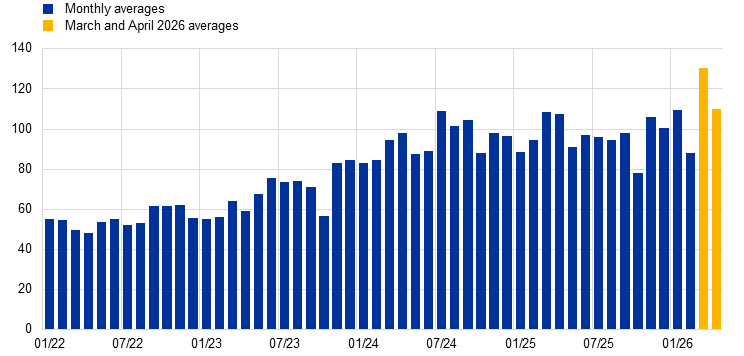
The war in the Middle East, which began on 28 February 2026, may drive further shifts. The outbreak of the war coincided with a significant surge in settlement activity on China’s Cross-Border Interbank Payment System (CIPS), which increased by about one-third in March 2026 compared with the average of the previous 12 months (Chart 15). Industry experts have suggested that the conflict could serve as a catalyst for an expansion of the renminbi’s role in global oil markets. Notably, reports indicate that some ships made payments in renminbi via CIPS or crypto-assets to transit through the Strait of Hormuz in March and April 2026.[42] Reports further suggest that customer-related cross-border payments by Chinese banks in renminbi reached a historical high of USD 1.4 trillion in March 2026, up by roughly 30% compared with the previous month.[43] The March 2026 increase in CIPS activity is even more noteworthy as it follows a marked deceleration in CIPS growth in 2025, with the total payment value increasing by 3% to USD 25 trillion annually – compared with the over 20% growth recorded the previous year.[44] At the same time, China modified its CIPS rules to enable settlements beyond the Chinese renminbi, effective as of 1 February 2026.[45] This shift towards a global multicurrency platform may also have contributed to the recent increase in CIPS activity.
Chart 15
Settlement activity in CIPS increased significantly in March 2026
(USD billions at constant Q4 2025 exchange rates)
Sources: CIPS and ECB staff calculations.
Note: Monthly averages of daily settlement volumes. The latest observation is for April 2026.
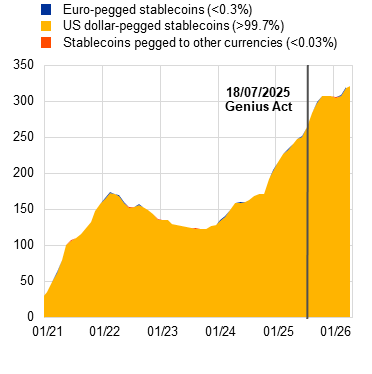
Finally, the stablecoin market continued to expand in 2025, remaining overwhelmingly dollar-pegged. Stablecoins are crypto-assets designed to keep a stable value, typically pegged to a fiat currency (mainly the US dollar to date) and backed by reserves. They hold the promise of improving cross-border payments by enabling faster, cheaper, 24/7 transfers that bypass traditional correspondent banking networks. By the end of 2025, stablecoin market capitalisation exceeded USD 300 billion, 50% higher than in 2024, in the wake of the adoption of the US Genius Act, which aims to provide a legal framework for payment stablecoins and is expected to be implemented by 2027. Almost all stablecoins continue to be pegged to US dollar-denominated assets (Chart 16, panel a).
Whether the growing use of stablecoins has the potential to reshape the international currency landscape remains to be seen. Stablecoins are to date mainly used to facilitate trading in more volatile crypto-assets, while their use in real economy payments is still more limited. For example, a recent study estimates that only around USD 400 billion of stablecoin retail payments are settled annually, which is equivalent to a market penetration below 0.01% in the business-to-business or business-to-consumer segments. In addition, global retail cross-border market transactions reach around USD 44 trillion – a hundred times more.[46]
More widespread stablecoin use could, however, have broader global macroeconomic implications. For instance, it could strengthen the link between the issuer country’s capital markets and foreign demand, as changes in demand for stablecoins abroad lead issuers to buy or sell bonds backing the tokens. Moreover, digital capital flows from foreign countries into or out of stablecoins would have an impact on the role of the exchange rate as a shock absorber and the transmission of shocks across jurisdictions. Recent research by ECB staff shows that if stablecoins were issued to a significant extent in the United States, a US contractionary monetary policy shock would trigger stablecoin redemptions by foreign users.[47] These stablecoin redemptions would in turn trigger capital outflows from the United States that would limit the dollar’s appreciation following the policy shock. Since the dollar would rise by less, foreign countries’ exports to the United States would decline more than they would without this moderation, thereby amplifying the spillover effects of US monetary policy shifts to foreign economies (Chart 16, panel b). By the same logic, the model also suggests that strong stablecoin issuance may increase US vulnerability to foreign monetary shocks. A contractionary monetary policy shock abroad would lead instead to stablecoin purchases, driving capital flows into the US that would strengthen the dollar and amplify the shock’s contractionary impact on US output.[48] Further research shows that if non-euro-pegged stablecoins were to become an important means of payment within the euro area, fluctuations in their demand could effectively import foreign monetary conditions into the domestic economy.[49]
Chart 16
More widespread use of stablecoins could have broad international macroeconomic effects
a) Market capitalisation of stablecoins |
b) Simulated responses to a US monetary policy shock on foreign variables |
|---|---|
(USD billions) |
(percentage change from steady state) |
 |
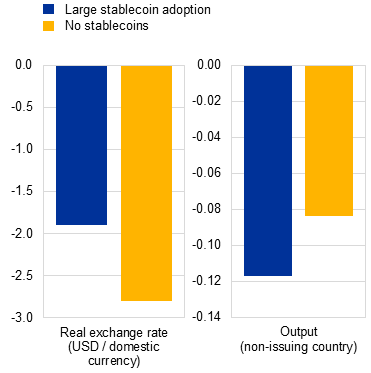 |
Sources: Artemis Analytics, Ferrari Minesso and Siena (2026) and ECB staff calculations.
Notes: In panel a) the latest observations are for April 2026. Panel b) shows the impulse responses to a US monetary policy shock that increases interest rates by 10 basis points in a model simulation without stablecoin issuance in the United States vs. another simulation where the issuance of stablecoins reaches about 2 USD trillion. Responses of the bilateral real exchange rate against the US dollar (expressed as US dollar per unit of foreign currency) and foreign output are reported as deviations from the model’s steady state values.
In a rapidly evolving global landscape, the Eurosystem is continuing to take steps to enhance the euro’s attractiveness as an international payment currency. First, TIPS – the euro area’s fast payment system – has enabled settlement of cross-currency transactions with the Swedish and Danish krona since October 2025 and work is under way to interlink it with the fast payment systems of other countries such as India and Switzerland, as well as Nexus Global Payments – a fast payment hub developed in South-East Asia. These initiatives aim to reduce intermediaries, shorten transaction chains and lower costs, boosting the euro’s appeal as an international currency. Second, the Eurosystem is developing the digital euro – the digital equivalent of cash. Particularly at a time of growing geopolitical tension, the digital euro will strengthen Europe’s autonomy in payment system infrastructures, currently reliant on international providers across virtually all digital use cases, from e-commerce to person-to-person to in-store transactions. Moreover, the digital euro is designed with potential international use in mind, in a way that respects other countries’ sovereignty and avoids unwanted currency substitution.[50] Having entered its next phase in October 2025, the digital euro could be issued by 2029 if EU legislators adopt the regulation in 2026. Third, on the wholesale side, the Eurosystem’s Pontes initiative will settle DLT-based transactions in central bank money in the third quarter of 2026 by connecting TARGET services to the new DLT platforms. In parallel, the Appia project aims to further develop an integrated digital asset ecosystem in a public-private partnership. These technologies will ensure more efficient and integrated financial markets, fostering sustainable growth and investment while strengthening the euro’s global financial role. On 31 March 2026 the Eurosystem outlined its comprehensive payment strategy covering wholesale, business-to-business, retail and cross-border transactions, to ensure that central bank money remains a trusted anchor of stability amid rapid technological change, bolstering the euro’s global appeal.[51]
Box 1
The euro as a safe-haven currency amid geopolitical tensions and policy uncertainty
Prepared by Martina Jančoková, Enrico Mallucci, Martino Ricci and Luca Tondo
Safe-haven currencies offer refuge to investors during periods of market stress. Global risk-off episodes trigger capital flows into safe-haven assets that are expected to retain value or even appreciate in periods of stress. These portfolio-rebalancing decisions often result in temporary declines in the yields of highly rated sovereign bonds, such as US Treasuries and German Bunds, while safe-haven currencies such as the US dollar, the Swiss franc and the Japanese yen typically appreciate (Chart A, panel a). Historically, the euro effective exchange rate has experienced only modest appreciations during risk-off events compared with other safe-haven currencies (about 0.1%, against almost 0.7% for the Swiss franc).[52]
More
Box 2
Global safe assets and their convenience yields
Prepared by Mar Domenech Palacios, Roberto Gandolfi, Georgios Georgiadis and Linda Rousová
A safe asset is a financial instrument with negligible default risk that is highly liquid, maintains a stable value and is widely trusted by investors.[53] It is often compared to a “good friend” on whom one can count when needed: it remains highly liquid and tends to hold its value even during systemic crises, making it a reliable store of value and source of collateral.[54] In the international financial system, global safe assets primarily consist of highly rated sovereign debt securities. Central banks invest a significant portion of their foreign exchange reserves in these securities.
More
Box 3
New indicators of the euro’s global appeal from the euro area international investment position
Prepared by Roberto Gandolfi, Linda Rousová and Martin Schmitz
This box presents novel indicators to assess the euro’s global appeal, based on newly available currency breakdowns in the euro area international investment position (IIP). Specifically, the indicators show the currency composition of the euro area’s cross-border assets and liabilities – denominated in euro, US dollars and other currencies – excluding intra-euro area positions. The indicators, which are fully consistent with official ECB data on the euro area IIP, are constructed from the euro area and individual countries’ IIP data, complemented with estimates based on the ECB’s securities holdings statistics and the Bank for International Settlements’ locational banking statistics.[55]3
MoreSee more here.
© European Central Bank, 2026
Postal address 60640 Frankfurt am Main, Germany
Telephone +49 69 1344 0
Website www.ecb.europa.eu
All rights reserved. Reproduction for educational and non-commercial purposes is permitted provided that the source is acknowledged.
For specific terminology please refer to the ECB glossary (available in English only).
The cut-off date for the statistics included in this report was 30 April 2026.
PDF ISBN 978-92-899-7911-5, ISSN 1725-6593, doi:10.2866/0873107, QB-01-26-155-EN-N
HTML ISBN 978-92-899-7910-8, ISSN 1725-6593, doi:10.2866/0887771, QB-01-26-155-EN-Q
Legal Disclaimer:
EIN Presswire provides this news content "as is" without warranty of any kind. We do not accept any responsibility or liability for the accuracy, content, images, videos, licenses, completeness, legality, or reliability of the information contained in this article. If you have any complaints or copyright issues related to this article, kindly contact the author above.
